
Hi Friends,
This is JP Allen, founder and owner of Harmonica.com. Over the years, I've heard the same complaint from hundreds of students: "I can dabble with the harmonica, but I don't feel confident playing songs or jamming over the blues."
After years of attempting to find a solution, I was never satisfied … until now. With my brand-new, Jam-Along Song System, I can finally help you sound great playing songs in a way that's fun and easy.
What makes my Jam-Along Song System different than my other harmonica video lessons (or any other harmonica lessons out there)?
This step-by-step, cutting-edge method focuses on SONGS, SONGS, SONGS!!! Whether you're a beginner or someone who has been playing for quite a while, in less than a month you'll be playing jaw-dropping blues ... and easily performing some of the most popular harmonica songs on the planet.


JP has really hit a homerun with these song generators. I have found it to be one of the fastest ways to learn a harmonica song. It gives you everything you need, the tabs, the melody, the timing and even the articulation for each note. Its really a great method to learn a song very quickly.
Guy
Swartz Creek, Michigan




When you play along, you get to hear how the songs sound. Knowing that you are playing the songs correctly will keep you inspired and help you master the songs quickly and easily.

If you're a beginner, you can start with easier songs and build up to the advanced level.
One of the secrets to successfully learning a piece with accuracy is to start slow. Once you master a song playing slow, you can make it a game to challenge yourself to play a little bit faster every day. My Jam-Along Song System makes this easy, because you can control the tempo as you progress.


Expand your repertoire with my Jam-Along Song System, which offers a great selection of music — blues, folk, traditional, and classical.
With my Jam-Along Song System, you get 50 great songs … PLUS 25 bonus blues solos … PLUS 75 recordings of professional harmonica performances.
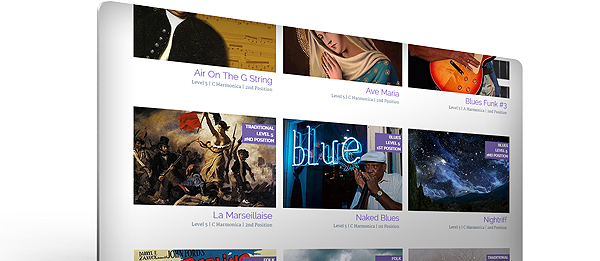
Many of the pieces include a jam section, where you can jam along — either repeating the melody notes or improvising on your own!
This is not just a "thrown together" collection of some of the most popular harmonica songs and awesome blues solos. It's much more than that. It's a complete course which will take you to advanced levels of performance ... step-by step ... song by song. Check out how the Road Map works in this video:

I love your new harmonica song system. The variety of songs and genres is great. I love that you can search by song title, difficulty level or genre. I also appreciate that you have the ability to speed up or slow down the player as your level of play changes. One other feature I really like is that you can see the entire song on the screen rather than waiting for the curser to scroll down while the music is playing. I'm addicted!
I developed the Jam-Along Song System with the help of some of the finest harmonica players on the planet, over the course of two years. These teachers include Joe Powers, Michael Rubin, Michael Brebes, Sam Friedman, JP Allen, and Jason Curran.
This means not only that you'll learn and hear some phenomenal original perfomances but also that ALL songs included with the system are deadly accurate, to the note (no need to suffer with annoying incorrect harmonica tabs any longer)





Instant access as soon as you order
Money-back guarantee
Compatible on all computers, laptops, tablets + mobile devices
Includes real harmonica performance audios
If this product does not skyrocket your ability to play harmonica songs (and sound good!) in 60 days, we will refund your money — no questions asked.
All you have to do is contact me and I'll get back to you fast: Contact Us Here, or call my support team on 1-800-292-4963 within 60 days of your purchase and Harmonica.com Will Give You a Full Refund (No Questions Asked)
Why do I offer this guarantee with such confidence? Simple: you will not find an easier or more effective way of learning actual harmonica songs, at your own speed, anywhere else. Also, if you learn one song each week, there are enough songs to keep you going for well over a year!

The Fluor Piping Design Guide (often referenced as the Fluor Daniel Piping Engineering Design Guide) is a comprehensive set of technical standards and administrative practices used globally in the petrochemical, power, and industrial sectors. Designed to standardize the execution of complex piping projects, this guide covers everything from conceptual layout to mechanical completion. Below is a detailed exploration of the core sections and practices typically found within this industry-standard resource. 1. Scope and Technical Practices The guide is structured into over 100 administrative and technical piping practices. These documents serve as the primary resource for designers, providing specific instructions for: Drawing Numbering & Checking: Standardizing how isometrics and plans are labeled and verified. Plant Arrangement: Guidelines for Plant Arrangement (000.250.2041) , which dictates how equipment is spaced and oriented. Material Specifications: Comprehensive charts for fittings, flanges, and valves. 2. Piping Hydraulics and Sizing A critical section of the Fluor guide focuses on the physical behavior of fluids within the system. Key technical parameters include: Pressure Drop & Velocity: Guidelines for economic pipe diameter and limitations on fluid velocity to prevent erosion and excessive noise. Phase Considerations: Specific design bases for single-phase liquid flow and single-phase gas flow. Pipe Characteristics: Detailed data on allowable line sizes and special cases for high-pressure or high-temperature service. 3. Stress Analysis and Support Systems One of the most used lessons in the guide involves Pipe Stress Analysis for layout studies. Thermal Expansion: The guide provides coefficient of expansion tables (000.250.9823) and procedures for calculating 3D loops in pipe racks. Support Elements: It defines standard components like Riser Clamps, Anchors, and Hangers . Functional Definitions: It clearly distinguishes between Guides (permitting longitudinal movement) and Anchors (restraining all movement). 4. Equipment-Specific Piping Layout The guide provides "Lesson Plans" for piping layout around various industrial units: Piping Engineering Design Guide | PDF - Scribd
The Blueprint of Industrial Flow: Principles and Practices in Piping Design In the landscape of industrial engineering, the humble pipe is often overlooked. Yet, for refineries, chemical plants, and power stations, piping systems are the circulatory system of the operation. A guide such as the hypothetical Fluor Piping Design Guide PDF represents the codification of decades of experience, safety protocols, and efficiency measures. While the specific document remains proprietary, the core tenets of such a guide—layout optimization, stress analysis, material selection, and safety compliance—form the backbone of modern process engineering. The Hierarchy of Design: From P&ID to Isometric Any authoritative piping design guide begins with the translation of a Process & Instrumentation Diagram (P&ID) into a physical, three-dimensional layout. The guide would emphasize the "Routing Philosophy": pipes should follow the shortest practical path, avoid interference with structural steel, and maintain accessibility for maintenance. A key principle is the concept of "line routing"—grouping high-temperature lines together, separating them from cryogenic services, and ensuring that critical lines (e.g., steam or emergency relief) have dedicated, unobstructed pathways. Furthermore, the guide would stress the importance of standardizing fittings and supports. Using a limited range of elbow radii, flange ratings, and support types reduces inventory costs and minimizes fabrication errors. The design guide acts as a rulebook for consistency, ensuring that an engineer in Texas and a fabricator in Singapore are working from the same playbook. Stress Analysis and Flexibility: The Silent Forces Unlike electrical conduits, pipes are dynamic entities. Thermal expansion, vibration, and pressure surges impose significant mechanical loads. A professional design guide dedicates substantial sections to flexibility analysis . It teaches engineers how to use natural loops (changes in direction) or expansion joints to absorb thermal movement without overloading equipment nozzles. The guide would reference ASME B31.3, the bible of process piping, but it would add company-specific safety factors. For example, while the code might allow a certain stress range for a carbon steel line at 400°F, Fluor’s internal standards might impose tighter limits on nozzle loads for sensitive rotating equipment like compressors or turbines. The guide also details when a simple hand calculation (e.g., guided cantilever method) suffices versus when a full computer-aided analysis (using software like Caesar II or AutoPIPE) is mandatory. Material Selection and Corrosion Control One of the most critical sections of any piping design guide is the Material Selection Matrix . It guides the engineer through the trade-offs between cost and longevity. For non-corrosive, low-temperature services (e.g., cooling water), carbon steel (A106 Gr. B) is standard. For high-temperature or corrosive hydrocarbons (e.g., sour crude), the guide would mandate chrome-moly alloys (P11, P22) or stainless steels (304/316L). The guide also addresses the "hidden" costs of corrosion, such as the need for corrosion allowance (typically 1/8" to 1/4" extra thickness) or chemical injection points. A modern design guide would also include clauses on Material Traceability , requiring that all high-alloy or critical-service pipes have heat numbers stamped and recorded—a crucial feature for safety audits and failure analysis. Layout and Spacing: The Art of the Practical While theory dictates minimum separation distances based on ASME/ANSI standards, a practical design guide offers "rules of thumb" for real-world installation. For instance:
Valve Accessibility: Handwheel centers must be between 3 and 5 feet above the working platform. Flange Alignment: No flanged joint shall be located directly above an electrical junction box. Drain Points: Every low point in a gas system must have a drain valve; every high point in a liquid system must have a vent.
The guide would also include standard Pipe Rack configurations, specifying how to tier lines (heavy lines on the bottom, small-bore and instrument lines on top) and how to plan for future "spare" capacity (typically 20-30% empty space on the rack). The Integration of Safety Standards In the post-Bhopal and post-Deepwater Horizon era, piping design is inextricably linked to process safety. A Fluor-style guide would explicitly integrate PHA (Process Hazard Analysis) recommendations into the design. This includes: fluor piping design guide pdf
Fireproofing: Identifying which lines (e.g., hydrocarbon feed lines within 25 meters of a fired heater) require fire-resistant insulation. Relief Systems: Ensuring that the inlet piping to a pressure safety valve (PSV) is shorter than the valve’s "rated" length to avoid chatter. Walkways and Egress: No piping component shall reduce a platform walkway to less than 24 inches in width.
Digital Transformation: 3D Modeling and Clash Detection The modern piping design guide is not just a PDF; it is a workflow integrated with software like SmartPlant 3D or Navisworks. The guide would stipulate Clash Resolution Protocols : a mechanical pipe has priority over an HVAC duct, but a firewater line has priority over almost everything. It would also define LOD (Level of Development) standards for 3D models, ensuring that every bolt, gasket, and weld is modeled before fabrication begins. Conclusion The Fluor Piping Design Guide PDF —whether viewed as a physical document or a conceptual standard—represents the translation of abstract physical laws (thermodynamics, fluid mechanics, metallurgy) into tangible, safe industrial assets. It is a tool for risk reduction and operational reliability. For the young engineer, it is a roadmap; for the seasoned designer, it is a check against complacency. Ultimately, such a guide ensures that the industrial fluids flowing at hundreds of degrees and thousands of PSI do so with silent, predictable obedience—a testament to the rigor of the design that preceded construction.
Disclaimer: This essay is a general discussion of common piping design principles used by EPC firms. It is not derived from nor a substitute for the actual proprietary documents of Fluor Corporation or any other specific company. For official design standards, always refer to published codes (ASME, API, ANSI) and your organization's internal guidelines. The Fluor Piping Design Guide (often referenced as
The Ultimate Resource for Engineers: Understanding the Fluor Piping Design Guide PDF In the world of industrial engineering, few names carry as much weight as Fluor Corporation . As one of the largest engineering, procurement, and construction (EPC) companies in the world, Fluor has developed proprietary internal standards that are considered the "gold standard" for piping layout, stress analysis, and material selection. For junior engineers, AutoCAD drafters, and even experienced piping designers, the search for the "Fluor Piping Design Guide PDF" is common. But what exactly is in this guide? Why is it so sought after? And where can you find legitimate resources to replicate Fluor’s best practices? This article serves as a comprehensive overview of the Fluor piping design philosophy, the key sections typically found in such a guide, and how to access high-quality piping design standards without violating copyright laws.
Why the Fluor Piping Design Guide is an Industry Benchmark Fluor’s internal design guides are not just manuals; they are the culmination of decades of experience across refineries, chemical plants, LNG facilities, and mining operations. Unlike generic textbooks (e.g., Crane TP-410 or ASME B31.3), the Fluor guide is action-oriented . Key Differentiators:
Risk Mitigation: Fluor prioritizes safety in layout. Their guides emphasize "blast-resistant" spacing and egress paths. Constructability: Details like flange alignment, bolt length calculation, and weld spacing are dictated to reduce field labor costs. Modularization: Fluor is a leader in modular construction. Their piping guides often include specific chapters on module split lines and spool piece definition. Plant Arrangement: Guidelines for Plant Arrangement (000
Engineers who study Fluor’s methodology often see improved efficiency in their own plant designs.
Core Sections You Will Find in a Fluor Piping Design Guide (PDF Format) While the actual Fluor internal PDF is proprietary and not legally available for public download (outside of employee access), numerous training institutions and ex-Fluor engineers have published summaries and derived works. A typical Fluor-style guide includes the following critical chapters: 1. Piping Layout Philosophy (The "Grid System") Fluor uses a strict orthogonal grid system. The guide details: